Targeted cooling
Depending on the fuel, rows of grate bars can be air- or water-cooled. A combined version is also possible.

Water cooling for the reciprocating grate: type 715 is based on the air-cooled type 415. The design of the grate rows can be matched to the properties of the fuel.
Discover grate 715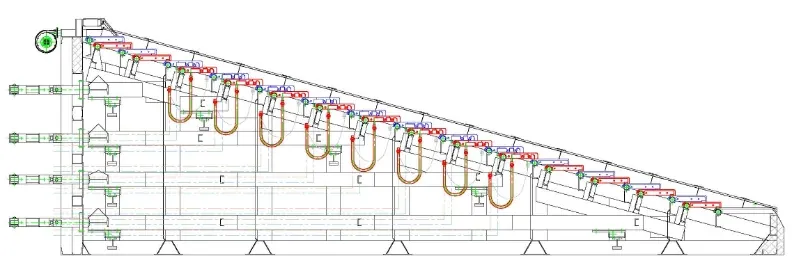
Water-cooled grate rows are used for high-calorific fuels. The circuit shows how the cooling lines are integrated into the cooling system.
Original diagram · example circuit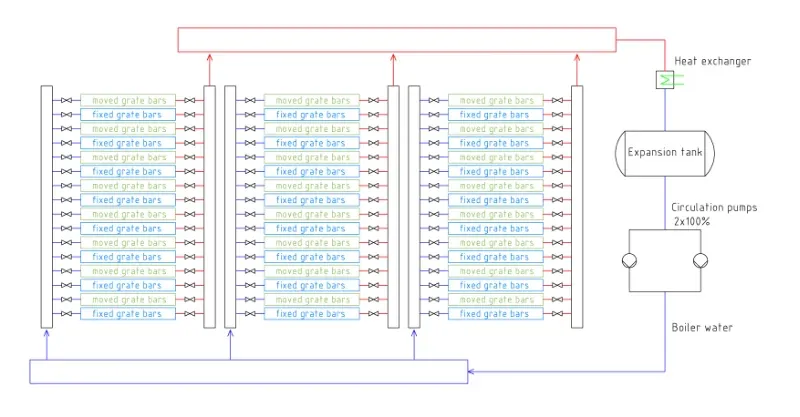
Fuel movement and air supply are matched to each other.
Depending on the fuel, rows of grate bars can be air- or water-cooled. A combined version is also possible.
Type 715 is compatible with type 415. For retrofitting, the grate surface and piping are adapted.
Reverting to pure air cooling is also possible if requirements change because of a different fuel.
Water-cooled reciprocating grate and adaptation of existing systems.
| Grate type | Design | Application | Details |
|---|---|---|---|
| Grate 715 | Stepped reciprocating grate | Water-cooled reciprocating grate based on type 415. | View type 715 |
Water-cooled reciprocating grate based on type 415.
Type 715 is the water-cooled variant of the air-cooled type 415 for fuels with a high calorific value. Water cooling is intended to reduce wear on the grate bars. The reduction in wear is not quantified.
Any proportion of the grate rows can be air- or water-cooled. The specific configuration depends on the properties of the fuel.
Compatible grate bars can be exchanged without modifying the grate frame. Conversion to water cooling still requires planning and adaptation of the piping.
Grate systems for biomass, waste wood and refuse-derived fuels
Ask Kablitz for the technical documents relevant to your product and application.
Request documents by emailDiscuss fuel, operating conditions and required output with Kablitz.
Get in touchDescribe the fuel, available quantity, moisture content and required energy output. An existing fuel analysis and site information help match the combustion system to the project.
Yes. Technical checklist fields are optional: provide the data you already know and leave outstanding points for further discussion.
Start a project inquiry